Foreign Fee Codes on Your Bank Statement: INTL TXN FEE, NON-STG & More
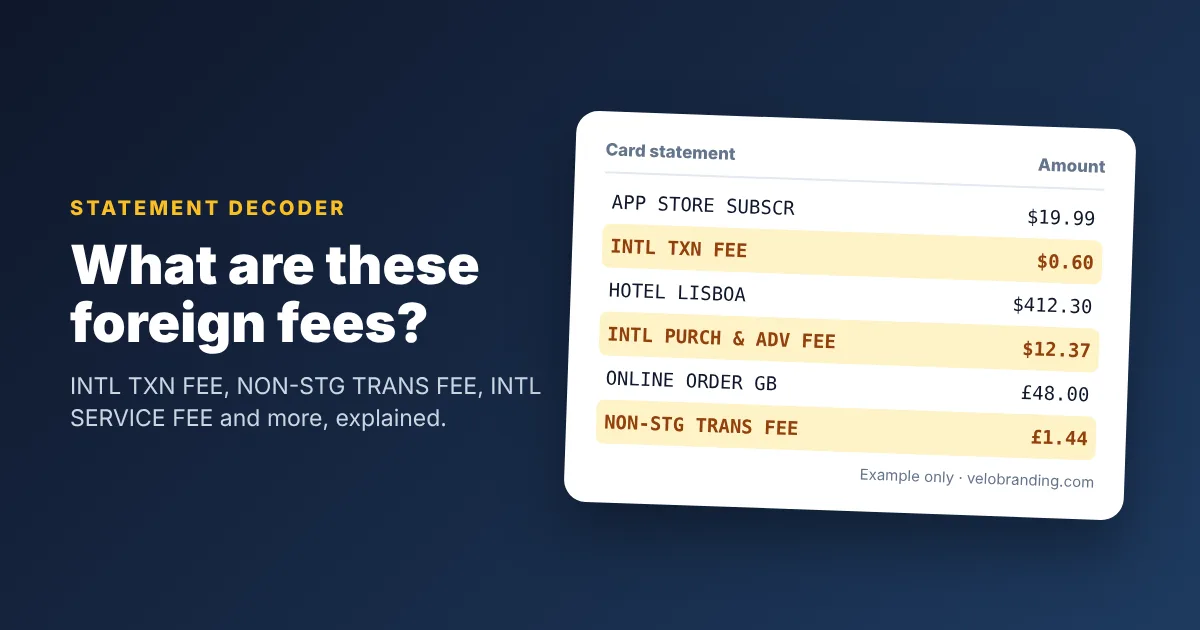
Quick answer: lines like INTL TXN FEE, INTL PURCH & ADV FEE, INTL SERVICE FEE or NON-STG TRANS FEE are all foreign transaction fees: a small extra charge, usually about 1%–3% of the payment, that your bank or card adds when you pay abroad, in another currency or with a business based in another country. They are normal, not fraud — as long as you recognise the purchase next to them.
Foreign fee codes and what they mean
| Statement text | Where you see it | What it means |
|---|---|---|
| INTL TXN FEE / INTERNATIONAL TRANSACTION FEE | US banks and credit cards | Foreign transaction fee on a purchase abroad, in a foreign currency or with a foreign business. |
| INTL PURCH & ADV FEE | US credit cards and credit unions | International fee on a purchase (PURCH) or cash advance (ADV) — the same kind of fee, covering both. |
| INTL SERVICE FEE / ISA FEE | US banks and credit unions | A foreign fee shown as its own line. One banking help page says it is assessed by Visa and Mastercard and has to be listed separately. |
| FOREIGN TRANSACTION FEE / FX FEE | Most countries | The plain name for the same charge. |
| NON-STG TRANS FEE / NON-STG PURCH | UK banks | Non-sterling transaction fee: you paid in a currency other than pounds. See non-GBP transaction fee. |
| NON-GBP PURCH FEE / NON-GBP CASH FEE | UK banks | The same non-sterling fee on a purchase, or on a cash withdrawal abroad. |
| FOREIGN CURRENCY PURCHASE FEE | UK banks (for example Halifax) | A fixed fee per foreign purchase, charged on top of the percentage fee on some cards. |
| ESTIMATED FOREIGN SETTLEMENT FEE | Brokerage / investing statements | Not a card fee: a charge some brokers add for trading foreign shares that do not settle through the US clearing system. |
Banks shorten these names differently, so your statement may not match word for word. The fee usually appears as its own line on the same day as the purchase or a day or two later.
How much these fees usually cost
| Example | Foreign fee on card purchases | Notes |
|---|---|---|
| Typical US credit card | About 1%–3% | Many travel and premium cards charge 0% |
| Bank of America debit cards | 3% | As listed by Wise (2022); plus $5 at non-US ATMs |
| Barclaycard (UK) | 2.99% non-sterling transaction fee | Applies abroad, in the UK and online with non-UK retailers |
| Halifax debit cards (UK, most accounts) | 2.99% + £0.50 per purchase | £1.50 for foreign currency cash; some accounts are fee-free |
| Halifax credit cards (UK) | 2.95% | Clarity Card has no foreign fee |
Sources: Credit Karma (updated August 2026), Wise’s Bank of America guide (checked March 2022), Barclaycard and Halifax “using your card abroad” pages (checked November 2026). Fees change and vary by account — check your own card agreement.
Example: what the fee adds
| Purchase | Fee at 1% | Fee at 3% |
|---|---|---|
| $20 app subscription | $0.20 | $0.60 |
| $100 online order | $1.00 | $3.00 |
| $1,000 hotel bill | $10.00 | $30.00 |
Small on one purchase, but on a trip or a year of foreign subscriptions it adds up — and the exchange rate can cost more than the fee itself.
Why you can see it without leaving the country
- The business is based abroad — many apps, games, software tools and marketplace sellers bill from another country.
- The price was in another currency — for example a subscription priced in USD or EUR.
- The payment went through a foreign bank — some cards charge the fee whenever the merchant’s bank is outside your country, even if you paid in your own currency.
If you do not recognise the purchase next to the fee, contact your bank straight away — the fee itself is normal, but an unknown purchase can mean your card details were used by someone else.
How to avoid foreign transaction fees
- Use a card with no foreign transaction fee for travel and foreign online purchases.
- Pay in the local currency when a card machine or ATM abroad asks. Choosing your home currency means the shop converts it, usually at a worse rate.
- Check where an online seller is based before paying, and compare its price with a local seller.
- Avoid cash advances on a credit card abroad — they can add a cash fee, the foreign fee and interest from day one.
- Ask for a refund of the fee if a business showed you the price as local but billed from abroad without saying so; some will refund it.
Work out the fee on your own payment
The free international transaction fee calculator shows the foreign fee and the exchange-rate cost on any amount, before you pay. For the full picture by country and card type, read International transaction fees explained.
Sources
Frequently asked questions
What does INTL TXN FEE mean on my statement?
It is short for international transaction fee: a foreign transaction fee your bank or card issuer charges on a payment made abroad, in a foreign currency, or with a business based outside your country. In the US it is often about 1%–3% of the payment.
What is INTL PURCH & ADV FEE?
It usually stands for an international purchase and (cash) advance fee: a foreign fee on a card purchase or a cash withdrawal made in another currency or with a foreign business. Check your card agreement for the exact rate.
What is a non-sterling transaction fee?
A fee UK banks charge when you pay in a currency other than pounds, abroad or online. Barclaycard, for example, charges 2.99%, and some Halifax debit cards charge 2.99% plus £0.50 per purchase.
Why was I charged a foreign fee on a payment in my own currency?
Some cards charge the fee when the business or its payment provider is based abroad, even if the price was in dollars or pounds. Online shops, apps and subscriptions are the most common cause.
What is an estimated foreign settlement fee?
It usually appears on a brokerage (investing) statement, not a bank statement. Some brokers charge it when you trade foreign shares that do not settle through the US clearing system; one broker lists it as usually $75 per trade.